Plate 1
Sample Depth 8892.0 ft
Click on thumbnail for zoom view.
| A. |
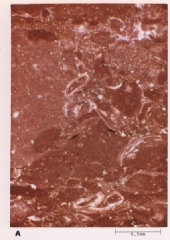
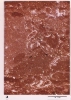
Overview of texture and porosity in stained portion of wavy-laminated, calcareous mudstone to wackestone (Lower "A" facies). Ostracode fragments (many shown here) are the most abundant grain types, with bivalve fragments, intraclasts, peloids, and possible algae present in minor amounts. Partial dolomitization is shown by numerous micro-crystalline dolomite rhombs (tan) partially replacing calcareous mud matrix. Small stringers of dark brown material at center are organic residue. Plane-polarized light. (40x) |
 |
| B. |
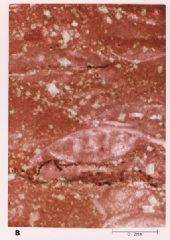
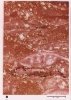
Detail of muddy carbonate texture shows microcrystalline, euhedral dolomite rhombs "floating" in and partially replacing pink-stained calcite matrix. Coarser calcite at lower right fills or replaces ostracode carapaces. Tight, well-cemented texture contains little if any visible porosity in this view. Also note microstylolitic concentrations of organic residue and pyrite at lower center. Plane-polarized light. (100x) |
 |
| C. |
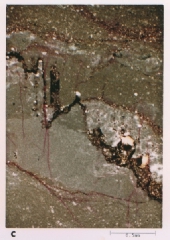
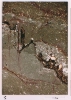
A prominent horizontal stylolite, defined by pyrite, organic material, and phosphatic grains (lower fight), cross-cuts texture in this general view. Magenta epoxy highlights numerous vertical and horizontal micro-fractures, though matrix porosity is generally sparse. Small dolomite rhombs replace matrix. Plane-polarized light. (40x) |
 |
| D. |
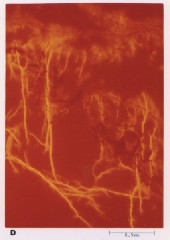
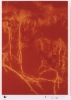
Same view as C, better illustrating network of micro-fractures associated with primary and smaller stylolites. Local patches of matrix microporosity, such as at upper right, define sites of matrix dissolution along more permeable stylolite or fracture pathways. Matrix porosity is typically poor in nonfractured beds. Reflected ultraviolet light with rhodamine filter. (40x) |
 |
|