Plate 2
Sample Depth: 8898.0 ft
Click on thumbnail for zoom view.
| A. |
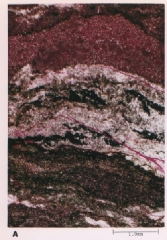
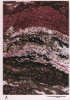
Low-magnification overview shows several interlaminated rock types characteristic of the anhydrite/Upper "B" contact: porous, dolomitic cryptalgal(?) mudstone, anhydrite (white), and less porous dolomitic mudstone, with several organic/pyritic interlaminae. Porosity is abundant, but definitely lamination controlled; algal dolomite and other dolomites are generally porous, whereas anhydrite beds are characteristically nonporous. Horizontal microfractures within laminae are common (center), but vertical inter-connectivity between alternating layers is lacking. Plane-polarized light. (20x) |
 |
| B. |
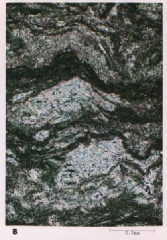
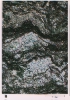
Inter-laminated anhydrite and dolomite in this view exhibit microfolds and microkinks, possibly of stromatolitic/cryptalgal origin. Anhydrite is easily recognized by its bladed habit and high birefringence. Numerous micro-fractures in anhydrite are highlighted with magenta epoxy. Crossed nicols. (40x) |
 |
| C. |
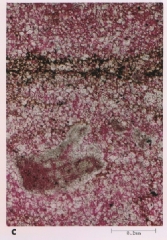
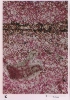
High-magnification view of texture and porosity in a dolomitic lamina. Dolomite typically exists as loosely packed, microcrystalline, subhedral-to-euhedral rhombs. Some inter-crystalline porosity is filled with dark organic material (center). Also note possible algal fragment at lower left. Plane-polarized light. (100x) |
 |
| D. |
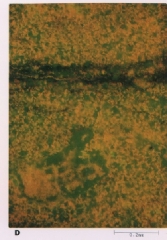
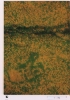
Same view as above illustrates pervasive inter-crystalline and micro, inter-crystalline porosity associated with loose dolomite texture. In addition, micro-porosity is visible in fragment at lower left. In spite of thin, organic permeability barrier at center, inter-crystalline pores appear generally well inter-connected and permeable. Reflected ultraviolet light with blue-violet filter. (100x) |
 |
|