Plate 3
Sample Depth: 8900.0 ft
Click on thumbnail for zoom view.
| A. |
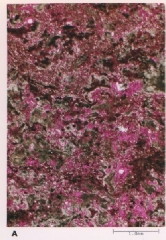
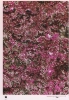
Textural overview of highly porous dolomitic mudstone to wackestone of the Upper "B" facies. Irregularly shaped nodules or intraclasts exhibit a lumpy or tubular algae texture; commonly encountered in the Upper "B" in other nearby Red River cores and identified as possible Dimorphosiphon. Approximately 19 percent porosity in this sample (magenta) is distributed as inter-particle pores between algal clasts, inter-crystalline pores, micro-pores, and dissolution pores. Small white patches of halite pore filling are recognizable at center. Plane-polarized light. (20x) |
 |
| B. |
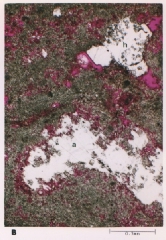
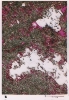
Large moldic, dissolution pores or micro-vugs also characterize this sample, and likely represent preferentially leached allochems. In this case, pores are almost entirely occluded by either coarsely crystalline anhydrite (a) or cubic halite (h). These two minerals rarely exist together in the same pore, so relative timing of precipitation is uncertain (though halite probably formed later). Dolomite in matrix is micro-crystalline, subhedral to anhedral, and variably packed. Crossed nicols. (40x) |
 |
| C. |
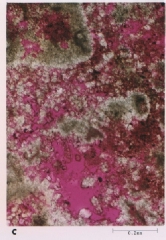
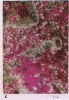
Detail of dolomite microtexture. Dolomite shape, size, and texture reflect original limestone texture: tightly packed, anhedral, dolomicrite replaces mud and muddy grains, whereas coarser more euhedral dolomite (lower center) is pore filling. Some immobile, organic residue composes dark material in several intercrystane pores. Plane-polarized light. (100x) |
 |
| D. |
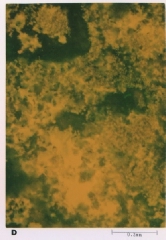
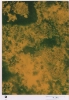
Same view as above highlights porosity types and distribution. Well-interconnected, inter-crystalline pores of 5-10u size are most common, though smaller, inter-crystalline micro-pores are also visible. Larger inter-particle or dissolution voids, such as at lower left, undoubtedly enhance permeability here (12-23 md). Nonporous patches (dark green or black) are areas of tightly packed dolomite or pore fill. Reflected ultraviolet light with blue-violet filter. (l00x) |
 |
|