Plate 4
Sample Depth: 8900.5 ft
Click on thumbnail for zoom view.
| A. |
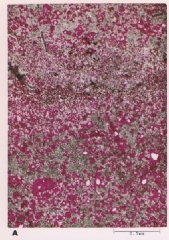
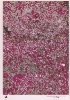
This highly porous, Upper "B" dolomite, like the one above, contains few skeletal grains apart from isolated ostracode or bivalve fragments. This sample, however, exhibits multitudes of small, rounded dissolution pores, results of extensive leaching of small, rounded allochems (peloids?). This moldic "Swiss cheese" texture is well illustrated in the lower half of this low-magnification view. Crude lamination is defined by thin stringers of organic material (center). Plane-polarized light. (40x) |
 |
| B. |
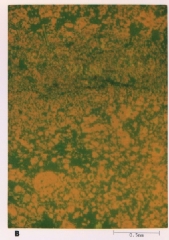
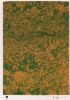
Same view as in A emphasizes highly porous texture created by dolomitization and dissolution. Pervasive moldic pores up to roughly 0.5 mm in size combine with inter-crystalline porosity to give >20 percent expected porosity and relatively high permeability. Note decrease in porosity where organic residue is present. Reflected ultraviolet light with blue-violet filter. (40x) |
 |
| C. |
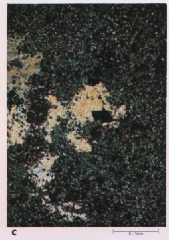
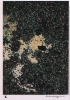
Another general view shows porous, micro-crystalline dolomite texture and pore-filling minerals. Coarse, blocky, mono-crystalline anhydrite (bright yellow here) is the dominant void-filling mineral, but close inspection of this view reveals small patches of an isotropic pore fill (center, likely halite). Texture here suggests that the isotropic mineral precipitated earlier, but it could also be replacing anhydrite. Crossed nicols. (40x) |
 |
| D. |
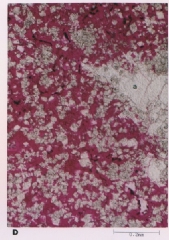
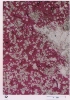
High-magnification view illustrates a loose array of micro-crystalline, euhedral to subhedral dolomite. Intercrystalline pores are comparatively large in relation to dolomite crystal size, and are effectively inter-connected. Also note immobile hydrocarbons residing in pores and patch of pore-filling anhydrite (a). Plane-polarized light. (100x) |
 |
|