Plate 5
Sample Depth: 8901.6 ft
Click on thumbnail for zoom view.
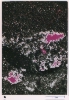
| A. |
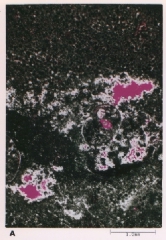
Overview of composition, texture, and porosity in dolomitized peloidal packstone. The presence of vug- and pore-filling chert and coarser silica (white) is characteristic of the tight, but thin, transition zone that separates the Upper "B" and Lower "B" lithofacies. Pervasive silica cementation has understandably reduced porosity to 6 percent here, and horizontal permeabilities are correspondingly low (0.41-2.9 md). Texture in the upper part of view is dominated by dolomitized peloids; a few ostracode fragments are also recognizable. Plane-polarized light (20x) |
 |
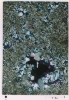
| B. |
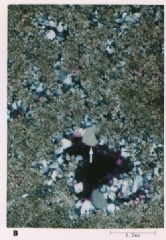
High-magnification view of dolomite texture and silica cement. Silica crystal size largely reflects size of associated pore or void: micro-crystalline chert fills small inter-crystalline pores and ostracode fragment (lower left), whereas coarser euhedral quartz was allowed to grow in larger voids (arrow). Carbonate texture is characterized by packed, subhedral/ anhedral, micro-crystalline dolomite. Also note that dissolution pores and vugs are not necessarily completely occluded by silica or other cements (this view and view A). Crossed nicols. (100x) |
 |
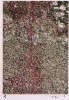
| C. |
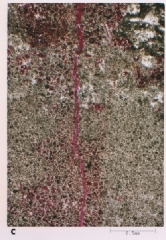
General, low-magnification view of peloidal texture cross-cut by an open microfracture. Distribution of magenta epoxy shows that some peloids near fracture are partially leached. Chert extensively fills interparticle porosity throughout this view. A partly silicified codiacean(?) alga fragment is visible at upper right (with tubule texture). Plane-polarized light. (40x) |
 |
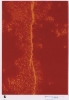
| D. |
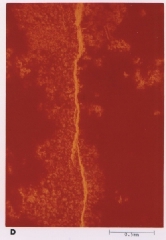
Same view as C, better illustrating network of micro-fractures associated with primary and smaller stylolites. Local patches of matrix microporosity, such as at upper right, define sites of matrix dissolution along more permeable stylolite or fracture pathways. Matrix porosity is typically poor in nonfractured beds. Reflected ultraviolet light with rhodamine filter. (40x) |
 |
|