Plate 6
Sample Depth: 8902.7 ft
Click on thumbnail for zoom view.
| A. |
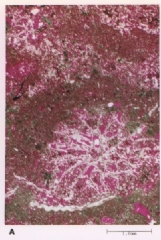
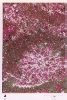
Typical Lower "B" dolomites just below the fight zone are characterized by very high porosity (>20 percent), a more diverse skeletal population than Upper "B" dolomites, and a greater abundance of micro-pores. This dolomitic wackestone is no exception, exhibiting fragments of bryozoans (lower center, upper left), brachiopods (lower center), pelmatozoan echinoderms, possible stromatoporoids, and algae (upper right), as well as a highly micro-porous texture overall. Several larger dissolution pores are visible, but most porosity is distributed among micro-intercrystalline pores within micro-dolomite matrix. Plane-polarized light. (20x) |
 |
| B. |
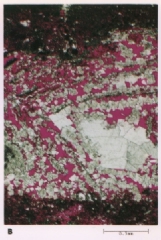
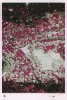
This general view represents part of porous plate-like feature with definite remnant internal structure, tentatively interpreted as a possible stromatoporoid fragment. Coarser, "clean", euhedral dolomite partially fills skeletal porosity at center. Plane-polarized light. (40x) |
 |
| C. |
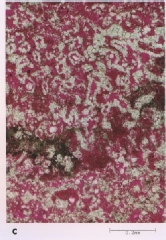
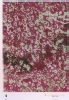
Detail of dolomite micro-texture shows dolomicrite and micro-crystalline, subhedral/ euhedral dolomite. Variations in dolomite crystal size and texture reflect textural characteristics of original limestone plus whether dolomite is replacive or pore filling. Plane-polarized light. (100x) |
 |
| D. |
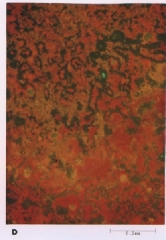
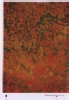
Same view as C shows the dominance of micro-porosity in the pore network. Reflected light also highlights remnant internal structure of a simple filamentous alga (Hedstroernia?) at upper left. Reflected ultraviolet light with blue-violet filter. (100x) |
 |
|