Petrographic Analysis of Ordovician Red River B Zone, Western Bowman Co., ND
Introduction and Analytical Procedures
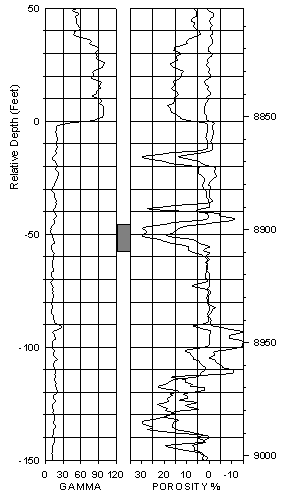
Petrographic analysis was conducted on core material representing the "B" cycle of the Ordovician Red River Formation. Samples were obtained from vertical core recovered in Bowman County, North Dakota. The Red River Formation in the Williston Basin is divided into lithologic/depositional cycles, "A", "B", "C" and "D", from youngest to oldest. Thin sections examined in this study represent the lower-most limestone from the "A" cycle, "B" cycle anhydrite, and the Upper "B" and Lower "B" porous dolomite lithofacies; reflect sedimentary textures and fauna/flora in the cycle "B" dolomites reflect deposition in a shallow marine, subtidal to intertidal, normal to restricted-saline setting.
Eight oversized (two-inch x three-inch) thin sections representing depth interval 8892-8915 ft (core depth) were prepared from full-diameter routine samples, vertically oriented core material adjacent to full-diameter samples, and end pieces of rock mechanics and relative permeability samples (1.5-in diameter plugs). Samples were impregnated with a low-viscosity, fluorescent red dye epoxy resin under high vacuum in order to penetrate intercrystalline, moldic, and micro-porous voids and fractures. Samples were then mounted on two-inch x three-inch glass slides and ground to a thickness of approximately 30 microns. A part of each thin section was stained with Alizarin Red "S" and potassium ferricyanide to aid identification of calcite, dolomite, and ferroan carbonates, All samples were petrographically studied using a Nikon binocular microscope with camera and ultraviolet light source attachments. Thin sections were analyzed and photographed under 20x, 40x, l00x, and 200x magnification using plane-polarized, cross-polarized and reflected ultraviolet light.